Did All Millets Originate in South India? Busting the Biggest Myths About Millets
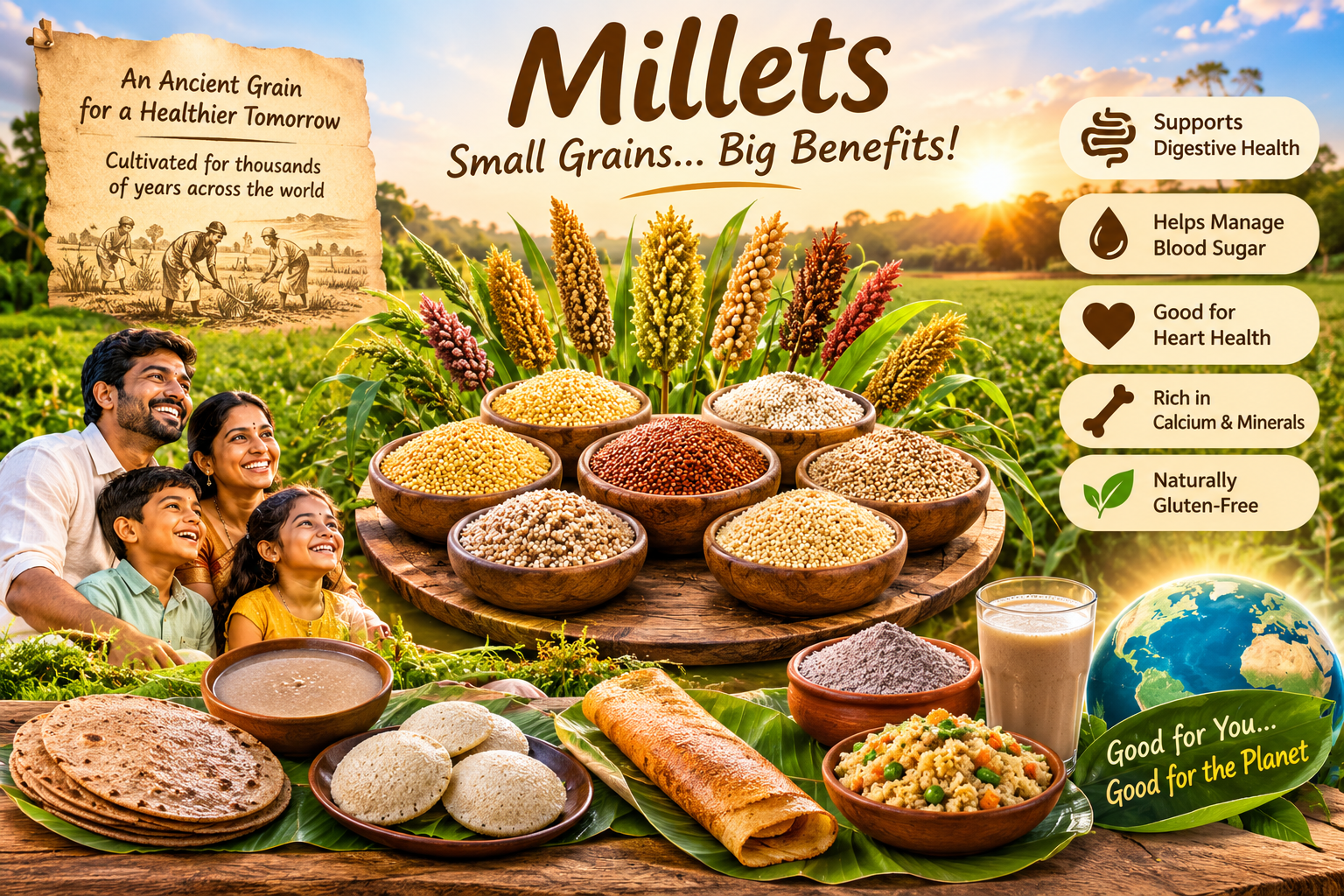
Millets: The Ancient Grains That Deserve a Place in Every Modern Kitchen
They fed generations before modern food trends existed. They survived difficult growing conditions, travelled across continents and became part of traditional cuisines. Today, these tiny grains are finding their way back into our kitchens. But what makes millets so special? Let’s explore their remarkable journey.
A forgotten food with an extraordinary story
Imagine a time when food came directly from the fields, meals were prepared with locally grown ingredients and families depended on the crops that could survive their region’s climate.
Long before packaged breakfast cereals and refined convenience foods became common, millets were an important part of everyday diets across Asia and Africa.
These small grains supported farming communities because many varieties could grow in regions where rainfall was limited and soil conditions were challenging.
Over generations, people developed recipes around the grains available to them. Some became breakfast porridges, others became flatbreads, steamed foods and traditional drinks.
In India, millets became closely connected with regional food traditions. They were practical foods, deeply rooted in agriculture and familiar to generations of families.
Today, we are rediscovering something that our ancestors already understood: food diversity matters.
Where did millets come from?
Millets do not have a single geographical birthplace. They are a diverse family of cereal crops that were domesticated in different parts of the world.
Archaeological evidence suggests that common millet and foxtail millet were cultivated in ancient East Asia thousands of years ago.
In Africa, crops such as pearl millet and sorghum became important sources of food. Finger millet has particularly strong historical roots in eastern Africa before spreading into India.
Over time, these grains travelled through trade, migration and agricultural exchange.
India became one of the important regions where millet cultivation and food traditions developed. Different communities adapted their farming practices and recipes to local conditions.
This is why millets are not just another category of health food. They represent thousands of years of agricultural knowledge.
Meet the different varieties of millets
One of the fascinating things about millets is their diversity. Each variety has its own taste, texture, cooking characteristics and nutritional composition.
Here are some varieties commonly used in India.
1. Ragi – Finger Millet
Ragi is especially popular in southern India. It is known for its calcium content and is commonly used to prepare ragi kali, ragi dosa, porridge and malt.
2. Kambu – Pearl Millet
Kambu is a traditional staple in many dryland regions. It is used in porridge, flatbreads and kambu koozh, a familiar summer preparation in Tamil Nadu.
3. Thinai – Foxtail Millet
Thinai has a long history in Indian food traditions. It can be used for pongal, upma, cooked grain dishes and sweet preparations.
4. Samai – Little Millet
Samai is a versatile small grain that can be used in place of rice in several recipes. It works well in upma, pongal and everyday cooked meals.
5. Varagu – Kodo Millet
Varagu is another traditional grain used in different parts of India. It can be prepared as a cooked grain, porridge or mixed with vegetables and pulses.
6. Kuthiraivali – Barnyard Millet
Barnyard millet is popular in fasting recipes and everyday cooking. It can be used for pongal, upma and other rice-style preparations.
7. Panivaragu – Proso Millet
Proso millet is used in several traditional and modern grain-based recipes. It provides plant protein and minerals.
8. Jowar – Sorghum
Jowar is widely used in Indian kitchens, especially for making rotis and traditional flatbreads. It is also used in porridge and modern millet-based products.
These are not interchangeable grains from a nutritional perspective. Each offers a different combination of nutrients, and choosing a variety of them is a useful way to diversify your diet.
Why are millets considered nutritious?
The real value of millets goes beyond their traditional reputation. They contain a range of nutrients that can contribute to a balanced diet.
However, one important point: not every millet contains the same amount of every nutrient. The variety, growing conditions, processing and preparation method all matter.
Dietary fibre for digestive health
Whole millet grains can provide dietary fibre, which supports normal bowel function and helps maintain digestive health.
Fibre also contributes to fullness after meals and supports a healthy dietary pattern.
Plant-based protein
Millets provide plant protein and can complement other vegetarian protein sources such as lentils, beans, chickpeas and nuts.
Combining different plant foods is a practical way to improve the overall nutritional quality of meals.
Minerals that matter
Different varieties provide minerals such as iron, magnesium, phosphorus and zinc.
Ragi deserves special mention because of its naturally high calcium content. It is one of the particularly useful cereal grains for people looking to diversify their calcium sources.
Naturally gluten-free
Millets are naturally gluten-free. This makes them useful alternatives for people who need to avoid gluten.
People with coeliac disease should still ensure that the grain and finished product are protected from cross-contamination during processing and packaging.
Can millets help with blood sugar management?
This is one of the most frequently discussed aspects of millet nutrition, and there is scientific research worth understanding.
A 2021 systematic review published in Frontiers in Nutrition examined 65 studies on millets and blood glucose-related outcomes.
The researchers reported that the millets included in their analysis had an average glycaemic index of approximately 52.7, although individual varieties and preparations differed.
The review also found evidence that longer-term millet consumption could improve certain blood glucose measurements in the studied populations.
But there is an important distinction.
A millet-based meal is not automatically low-GI simply because it contains millets. Grinding, refining, cooking, portion size and the other ingredients in a meal can influence how quickly carbohydrates are digested.
For a balanced meal, combine millet preparations with vegetables, pulses and suitable protein sources.
Millets can be part of a diabetes-conscious eating pattern, but they are not a substitute for medical treatment or individual dietary advice.
Are millets useful for weight management?
Let’s clear up a common misconception.
Millets do not directly burn body fat or cause weight loss.
Their potential value comes from their nutritional composition and how they are used in meals.
Whole-grain millet preparations can provide fibre and contribute to fullness. When used instead of some refined cereal foods, they can help create more balanced meals.
But portion size still matters. Millets contain carbohydrates and energy, just like other cereal grains.
A healthy diet is about overall food choices, not one miracle ingredient.
Millets and the environment: A story beyond nutrition
There is another reason why millets deserve attention.
Many millet crops are naturally adapted to dryland farming. Depending on the variety and agricultural conditions, they can tolerate heat, periods of low rainfall and less fertile soils.
This makes them valuable crops for farmers in regions where water availability and changing weather patterns create agricultural challenges.
Millets also contribute to crop diversity. Growing a wider range of crops can reduce dependence on a small number of staple cereals.
Their environmental advantages are not identical everywhere. Water requirements and agricultural impacts vary by crop, location and farming practice.
Nevertheless, millets have an important role in discussions about climate-resilient agriculture and sustainable food systems.
In 2023, the United Nations recognised their global importance by declaring it the International Year of Millets, with the Food and Agriculture Organization leading the initiative.
It was an opportunity to bring attention to crops that had received far less recognition than their contribution to food security deserved.
Bringing millets back to our kitchens
Perhaps the biggest challenge is not understanding millets. It is finding simple and enjoyable ways to include them in everyday cooking.
The good news? You don’t need to completely change your family’s food habits.
Start with familiar dishes and experiment with different grains.
Here are a few ideas:
Breakfast
Ragi dosa, thinai pongal, millet idli
Morning drink
Ragi malt or homemade millet health mix
Lunch
Samai rice, varagu rice or millet vegetable pulao
Evening
Millet-based snacks or homemade energy bars
Dinner
Jowar roti, millet dosa or vegetable millet upma
A simple approach is to replace one refined-grain meal occasionally with a millet-based alternative and gradually explore different varieties.
The best food is not just nutritious. It should also be enjoyable enough to become part of your regular routine.
Five common misconceptions about millets
Myth 1: All millets are the same.
Fact: Different varieties have different nutritional profiles, flavours and cooking properties.
Myth 2: Millets contain no carbohydrates.
Fact: Millets are carbohydrate-containing cereal grains. Their nutritional advantage comes from their overall composition, including fibre and minerals.
Myth 3: Eating millets automatically reduces weight.
Fact: Weight management depends on overall energy intake, food quality, physical activity and lifestyle.
Myth 4: Millets are only for older people.
Fact: Properly prepared millet dishes can be enjoyed by people of different age groups as part of a balanced diet.
Myth 5: Millets are difficult to cook.
Fact: Most millets can be prepared using familiar cooking methods. The soaking and water requirements vary by variety.
The future of millets starts with our everyday choices
There is something remarkable about the journey of these grains.
They began as essential crops for communities living in challenging agricultural environments. They became part of traditional food cultures. Then, as modern food habits changed, many of them slowly moved away from everyday kitchens.
Now they are receiving renewed attention.
Farmers are exploring opportunities to grow them. Food researchers are studying their nutritional properties. Food entrepreneurs are creating new products and recipes that make them easier to enjoy.
And families are rediscovering traditional ingredients in modern forms.
Perhaps that is the real story of millets.
We don’t have to reject modern food to appreciate traditional food. We can bring both together and make better choices.
A little grain. A big reason to rediscover our food heritage.
At Millet Sigma, we believe that traditional ingredients deserve a place in modern kitchens.
Our goal is to make millet-based nutrition more accessible through convenient food products that respect the value of their ingredients.
Whether you enjoy a traditional ragi preparation, experiment with foxtail millet or explore a millet-based health mix, every small step towards food diversity counts.
Let’s not allow these ancient grains to remain just a part of history. Let’s make them part of our future.
Millet Sigma – Celebrating the goodness of traditional grains.
Explore more at https://milletsigma.com/shop.
Further reading and research references
The article above is original editorial writing. These publications and institutional resources were consulted to verify the underlying facts:
- Food and Agriculture Organization (FAO) – International Year of Millets: background, varieties and nutritional importance.
https://www.fao.org/millets-2023/about/ - International Crops Research Institute for the Semi-Arid Tropics (ICRISAT) – Facts on Millets, 2024.
https://oar.icrisat.org/12404/ - Anitha et al. (2021) – A Systematic Review and Meta-Analysis of the Potential of Millets for Managing and Reducing the Risk of Developing Diabetes Mellitus. Frontiers in Nutrition.
https://doi.org/10.3389/fnut.2021.687428 - Indian Council of Medical Research – National Institute of Nutrition, Dietary Guidelines for Indians, 2024.
https://www.nin.res.in/dietaryguidelines.html - Longvah et al. (2017) – Indian Food Composition Tables. ICMR-National Institute of Nutrition.
This article is for general nutrition education and is not intended to replace individual medical or dietary advice.